"Magnifica Humanitas": Pope Leo XIV's Document on A.I. (Thoughts: Part 1...?)
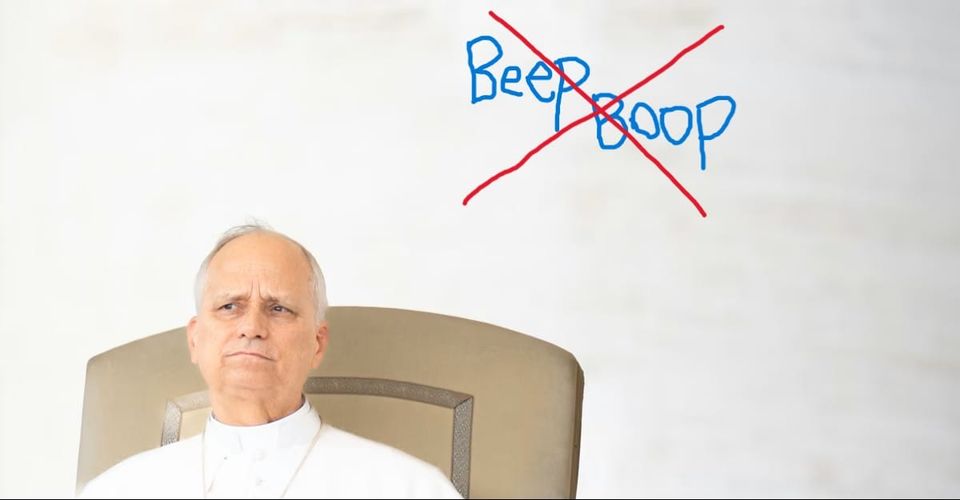
I'm halfway through Leo's encyclical and I have a couple thoughts so far.
First, there's some bangers in there. Like his predecessors' encyclicals post-Leo XIII, what you'll find in these documents are some statements that are so radical they'd even make some of your average Lefties blush. These statements often sit right next to explicitly Christian doctrine. For a secular audience (or an audience of a different tradition), this juxtaposition can give one wiplash. I remember reading Pope Francis's masterful Laudato Si and seeing how well it was received by the global Left (of which I consider myself a part), despite Francis including the unborn as part of his critique of the "culture of disposability." That's the thing that makes reading Catholic Social Teaching so complex. You have to hand it to them, though--the teaching is internally coherent and consistent. But it does sometimes result in a reader feeling consistently disoriented. We're used to modern ideological categories. It's super difficult to place Catholic Social Teaching in a neat, tidy category.
Back to Magnifica. There's the issue of human dignity and profit. Over and over again, Leo (in line with the previous handful of pontiffs) affirms that the human being is an end, not a means. The pursuit of profit and greater efficiency cannot justify the degradation of the human condition. The human cannot be subsumed in the machinery of automation and A.I for the maximization of profit. This is categorically immoral.
Paragraphs 103-105 and 107 discuss one of the issues with A.I. that I believe cannot be discussed enough: What does individual and corporate responsibility look like in the age of A.I. and algorithmicized decision making?
103. Indeed, entrusting an algorithm in practice with the power to select who is worthy or not, without anyone bearing responsibility for that judgment, is to hand over the task of redefining the boundaries of human possibilities. In this process, political responsibility is also lost, not just empathy toward those excluded, which can, after all, be simulated. The exclusion of the vulnerable becomes cloaked in a veneer of neutrality and objectivity, against which it becomes difficult to raise objections. In this way, injustice goes unnoticed, and compassion, mercy and forgiveness — understood not as mere appearances but as real political actions — gradually disappear from view.
104. From this follows a simple but compelling consequence: we cannot consider AI to be morally neutral. In reality, every technical tool embodies choices and priorities through what it measures, ignores and optimizes, and how it classifies people and situations. If a system is designed or used in a way that treats some lives as less worthy, or excludes them without the possibility of appeal, then it is not merely a tool “to be used well,” since it has already introduced criteria that contradict the inalienable dignity of the human person. For this reason, ethical discernment cannot be limited to asking whether we are using a system for good or bad purposes; it must also examine how that system is designed and what vision of the human person and society is embedded in the data and models that guide it.
107. We cannot be satisfied with merely calling for the moralization of machines — the so-called “alignment” of AI with human values — without also having the courage to insist on a further condition: the possibility of openly discussing the ethical frameworks involved and subjecting them to shared standards of social justice. Otherwise, those who control AI will impose their own moral vision, which will become the invisible infrastructure of these systems. A more moral AI is not enough if that morality is determined by a few. What is needed is a more active political involvement that is capable of slowing things down when everything is accelerating, and of protecting the opportunities for communities still to be able to participate and ask questions.
Who is responsible when an algorithm, A.I., or a chatbot specifically causes harm? And by "who" I mean human being(s). Head over to The Center for Humane Tech to learn about the Character.AI/Google lawsuit involving the suicide of a young man, Sewell Setzer III, that was prompted by his chatbot.
Google/Character.AI insists that it isn't responsible for what its A.I. does, essentially arguing that its chatbot has some version of First Amendment rights. They make this argument, as far as I can tell, by affirming the user's freedom of speech, which in turn informs how the chatbot generates its own "speech." So, that's how they make that argument.
A brief by the Electronic Frontiers Foundation tries to strike the balance between protecting the speech of the user (which they claim is tied up in the chatbot outputs) and leaving room for appropriate A.I. chatbot regulation, especially with regard to minors.
Anyway, all that to say I agree with Leo here. We simply cannot allow a society to develop where the chain of custody for responsibility is severed somewhere between the programmer and the end user.
It would be incredibly naive to misapprehend this: Big A.I. would love to abdicate criminal and civil responsibility to the algorithm. "We don't have control over what the A.I. does or says, therefore we aren't responsible." Bullshit. And that fact that this response is bullshit must be codified in the law.
Moving on.
Second, it doesn't go quite as hard as I was hoping it would. Most of what's really, forcefully radical in Leo's encyclical is already fully in line with the Church's teachings on economics, human dignity, and labor--things Francis said even more forcefully in his writings and public comments. Humanitas methodically applies the magisterial precedent to the issue of A.I. and the economies that are springing up around it. This is exactly what I wanted.
However, given my extreme suspicion of not just tech monopolies, the Pentagon, and assaults on labor, but also the very idea of the widespread use of A.I. in general, I was hoping for a more tech-suspicious-critical document. Perhaps unfairly, I was hoping for something with a little more Luddite flair.
It was probably not a reasonable expectation, since for some time now the Vatican has championed technological and scientific advancements. It sees its role as a moral guide for the implementation of progress in the service of the flourishment and dignity of humankind. Halfway through the encyclical, it's clear that Leo is asking for a slowdown, safeguards, and regulation among other things. All things I agree with. Yet, I think part of me was hoping for a call to Butlerian Jihad.
That's an issue of expectations I brought to the text, not of the text itself. Leo is an incredibly smart, measured man. Humanitas was always going to be radical in its teachings about human dignity and moral economics, but not rhetorically explosive.
I found myself nodding in agreement while reading Matthew Walther's New York Times piece "The Pope Should Be Going to War Against A.I. Why Isn't He?". His expression of bewilderment is perhaps a little stronger than mine, but I think it's fair from a certain point of view. Here's a taste:
The encyclical certainly does not live up to its billing as the A.I. equivalent of “Rerum Novarum,” the revolutionary text on the Industrial Revolution with which his predecessor and namesake Leo XIII inaugurated modern Catholic social teaching in 1891. The presence of Christopher Olah, a founder of the A.I. firm Anthropic, at the presentation of the encyclical on Monday rightly raised eyebrows. (Imagine if Leo XIII had invited John D. Rockefeller to hear him speak on the dignity of labor!)
For those of us who see the rise of A.I. as unambiguously evil, Leo’s emphasis on its ethical use is a nonstarter. He seems to underestimate A.I.’s ability to exacerbate existing crises and to accelerate processes of cheapening and redefinition. The encyclical says nothing, for example, about how A.I. abets the replacement of medicine as a humanistic profession with an algorithmic conception of health care justified by the language of “access.”
In perhaps the most telling passage, Leo contrasts the dangers of a myopic, self-aggrandizing “idealism” with what he calls “authentic realism,” a clearheaded outlook that “does not give up on changing the world” but rather, “by clearly identifying interests, fears, constraints and power dynamics,” is able to “determine what can be achieved, and the measures needed to achieve it.” (This, perhaps, is an implicit rebuke to technophobic critics.)
Pretty incisive stuff. As a person becoming more and more critical of mass A.I. use and more Ludditive (did I invent that conjugation?) as the days go on, I feel you Matthew. I feel you.
Later in the article, Walther articulates something I have been thinking about for years and have even worked into some pieces of science fiction I've been writing. Here it goes:
This is not to suggest that the church has nothing to say to the world about A.I. For years now I have believed that, in the face of the technological destruction of human relationships, literacy and contemplation, the church may well become the only guardian of humanistic values, even for secular people. But it will not fulfill this role by publishing encyclicals or issuing sterner disciplinary measures, but simply by staying true to itself.
[...]
How exactly the church’s message will reach a distracted world is unclear. But it will almost certainly not be a top-down endeavor, dependent upon the actions or personal charisma of a pope. What seems more likely is that in the decades to come we will see the emergence of a distinctly Christian cultural movement that defies standard political categories but is united against technological utilitarianism and the subsuming of human life into digital frameworks.
One day, I suspect a confederation of strange bedfellows will be a living testament of human dignity and freedom in a technocorporatefascist society. To that future world they make look like the Amish do to us now. Who knows? But I agree with Walther that religious instutitions and spiritual movements may just end up providing the prophetic and philosophical framework for that rebellion. Either explicitly or implicitly.
I'll likely do a follow up when I finish the encyclical. I'm eager to get to the places where Leo talks about labor, war, and human relationships.